Save your own copy
In Excel, use File > Save As and give your copy a name. Save again after making changes. Keep a fresh original for next time.
Your getting-started guide
Move work through Backlog, Ready, Doing, and Done using a task list.
Your first five minutes
Replace one task in A:H with a unique ID, task, owner, status, priority, due date, next step, and blocked flag.
See the fields in TasksChange a Status dropdown in Tasks to move its card. Set Doing limit in Board!B4 to your team limit.
See the fields in BoardIn desktop Excel, choose Data > Refresh All after task edits to update counts by owner and status.
See the fields in WorkloadAmber: your entries. Type your information here.
Green: calculated results. Keep these formulas.
Status colors can change as you work. Use the field instructions below to confirm what you can edit.
Follow along in your copy
The workbook already contains illustrative records so you can see how it works. Find these cells, make a small change following the first steps, and review the result before entering your own information.
These are sample values. Replace or clear the amber example cells before relying on your totals.
 Open the worksheet preview
New to spreadsheets?
In Excel, use File > Save As and give your copy a name. Save again after making changes. Keep a fresh original for next time.
The names along the bottom are tabs. Click one to open it. A cell is one box: B7 means column B, row 7.
Click an amber cell, type, and press Enter. Press Tab to move right. Double-click a cell to edit part of its text.
Click a cell with a dropdown, then click its small arrow and choose a listed option. The field notes list the available choices.
Enter dates such as 11/06/2026 and amounts as numbers, such as 1250. Enter 50% for half. Keep the existing number formats.
Press Ctrl+Z on Windows or Command+Z on Mac immediately after a mistake. A formula starts with = in the formula bar; keep it in place.
Keep this beside your workbook
Change statuses in Tasks. Cards update immediately. Refresh the Workload pivot separately. Editable cells begin at B4. Replace the examples with your information.
| Field and cells | What to do |
|---|---|
| Doing limit (B4) | Replace this amber setting with your own value. Check the related dates and inputs when changing the period. |
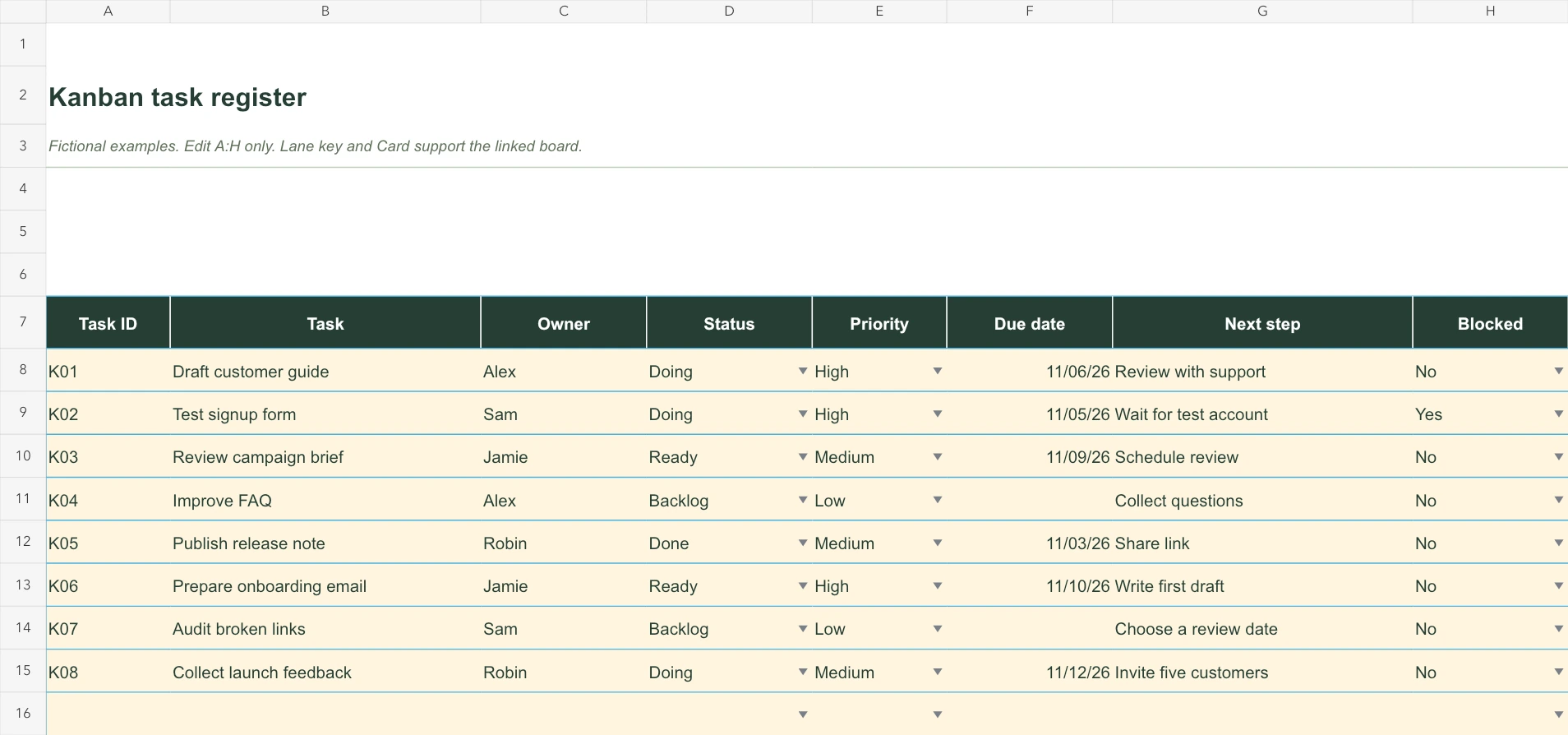
Fictional examples. Edit A:H only. Lane key and Card support the linked board. Editable cells begin at A8. Use the prepared amber rows for new records.
| Field and cells | What to do |
|---|---|
| Task ID A8:A47 | Give each task its own stable code, such as T01. Keep it unique. |
| Task B8:B47 | Replace the example with your own information for this record. |
| Owner C8:C47 | Replace the example with your own information for this record. |
| Status D8:D47 | Replace the example with your own information for this record. Choose: Backlog, Ready, Doing, Done. |
| Priority E8:E47 | Replace the example with your own information for this record. Choose: High, Medium, Low. |
| Due date F8:F47 | Enter a real date such as 11/06/2026. Use the same reporting period as the rest of the record. |
| Next step G8:G47 | Write a short, specific description that another person can act on or check. |
| Blocked H8:H47 | Replace the example with your own information for this record. Choose: Yes, No. |
Refresh after edits. Counts show task distribution; task effort is not estimated. Read the results here. Update the source tabs to change them.
Follow the steps above for this view. Use its amber settings where shown, and keep calculated totals and charts in place. Refresh the pivot after editing its source data.
Make it part of your routine
The filled rows are examples. Replace or clear their amber input cells so sample records do not stay in your totals. Keep formulas and headings.
Tasks has 40 prepared rows (8–47). Board cards update live. Keep the helper formulas in I:K. Workload counts tasks, not effort.
Use the prepared amber area shown in the field notes. Before adding rows outside it, extend all formulas, dropdowns, charts, summaries, and any pivot source that uses that area.
Leave an unknown value blank. Enter 0 when you have confirmed there is none. If you see Complete inputs or Add dates, fill the missing source fields first.
Check for leftover example rows, missing dates or amounts, mismatched names, and text entered instead of numbers. If a formula was replaced, Undo or copy it from a fresh original.