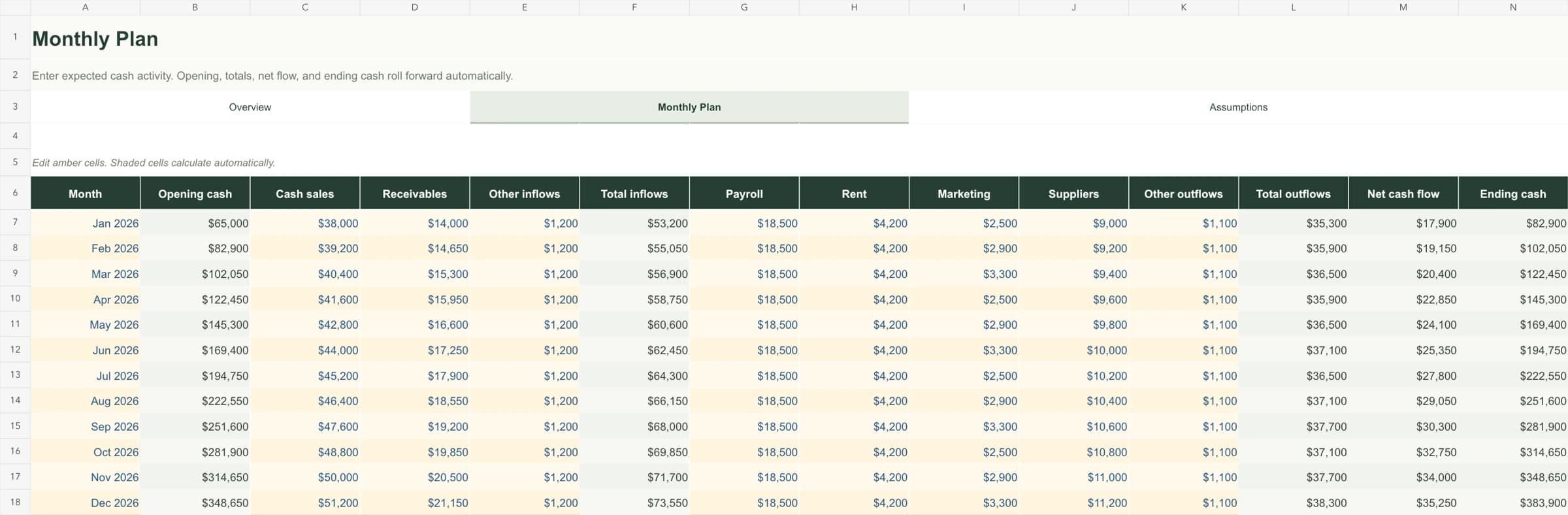
A cash plan follows when money enters and leaves an account. A profitable month can still have a cash shortfall if customers pay later or large bills fall due earlier.
Build the opening balance and monthly roll-forward before adding charts. Each month's ending cash should feed the next month's beginning cash directly.
Free tutorial for small teams and spreadsheet users. Examples use English-language formulas. Modern Excel is the workbook’s target app; Google Sheets imports require feature checks. Optional templates are separate one-time purchases with their own capabilities, limits, and terms on the linked product page.
01
Define the period and opening cash
Put the twelve months across B:M. Use row 2 for Opening cash, row 3 for Customer collections, row 4 for Other cash inflows, row 5 for Total inflows, row 6 for Cash payments, and row 7 for Closing cash. Enter the first month's opening balance in B2.
Use one currency and a consistent cash basis. Record loans, owner contributions, or asset purchases in clearly identified categories rather than mixing them into sales. Keep customer collections distinct from invoices issued.
02
Calculate one month's closing balance
In B5 use =SUM(B3:B4). Closing cash is opening cash plus inflows less payments. With $10,000 opening cash, $8,000 customer collections, $500 other inflows, and $7,000 payments, closing cash is $11,500.
Enter cash payments as positive amounts in this layout so subtracting the payment row has a clear meaning. Do not enter payments as negative and then subtract them again.
=B2+B5-B603
Link the next month directly
Set C2 equal to B7, then copy that opening-balance link through M2. Copy the monthly inflow total and closing-cash formulas across. Each month should follow the same timing convention.
If February has $9,000 collections, no other inflows, and $12,000 payments, it starts with $11,500 and closes with $8,500. Increase January collections by $1,000: January closing and every later opening balance should rise by $1,000 until another assumption changes.
=B704
Review timing and missing assumptions
Before presenting a result, confirm that every required month has a collection estimate and a payment estimate. Put zero only where no cash flow is expected. A blank assumption needs an explicit incomplete-input warning, not an automatic zero.
Review the lowest closing balance and the bills behind it. Try delayed customer collections in a working copy, keeping total collections traceable. This is an assumptions-based planning file; it has no bank feed, automatic reconciliation, or guarantee about future receipts.
Skip the blank-sheet setup
Cash Flow Planner
A 12-month cash plan, core assumptions, and a linked cash outlook.FAQ
Common questions
Can I use sales revenue as customer collections?
Only if the timing and amount of revenue and cash collection are actually the same. Otherwise schedule expected collections separately.
Why not calculate each opening balance from the first month again?
A direct link to the previous closing balance is easier to trace and avoids duplicating the cumulative calculation.