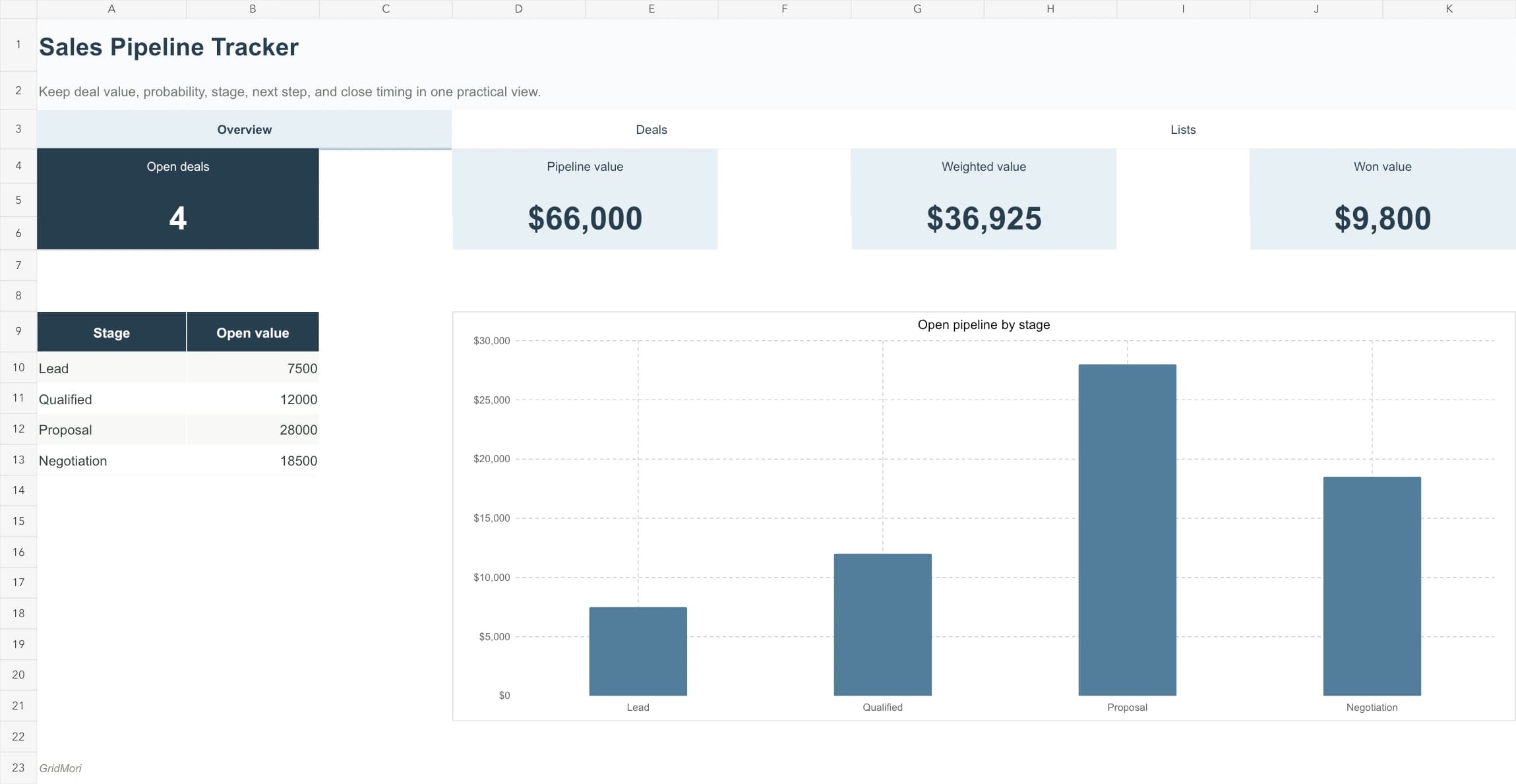
Weighted pipeline adds deal value multiplied by estimated win probability. It is useful for comparing an opportunity set under a consistent method. It is not a promise of future revenue or cash.
Choose a period and scope first. An open deal expected to close next quarter should not quietly inflate this month's pipeline review.
Free tutorial for small teams and spreadsheet users. Examples use English-language formulas. Modern Excel is the workbook’s target app; Google Sheets imports require feature checks. Optional templates are separate one-time purchases with their own capabilities, limits, and terms on the linked product page.
01
Give each deal a defined scope
In a new sheet, use Deal ID, Customer, Stage, Value, Win probability, Expected close, and Weighted value in A1:G1. Use a stable deal ID so updates do not create duplicate opportunities.
For an open-pipeline example, enter three deals at $10,000 and 20%, $8,000 and 50%, and $5,000 and 80%. Their unweighted total is $23,000. Keep won and lost deals separately labeled so the open-pipeline total has a clear meaning.
02
Keep probabilities visible and consistent
Use numeric percentages between 0% and 100%. If probabilities come from stages, maintain one stage-to-probability list. If a salesperson can override them, record that override explicitly rather than hiding it in a formula.
The example deals contribute $2,000, $4,000, and $4,000, for a $10,000 weighted total. A deal with a confirmed 0% probability contributes zero. A missing probability should remain an incomplete input.
=IF(OR(D2="",E2=""),"",D2*E2)03
Reconcile totals and close timing
Sum the weighted values for open deals expected to close in the period. Also show the unweighted value and deal count for the same population. Do not multiply the total pipeline by an unweighted average of deal probabilities.
For the three example deals, averaging 20%, 50%, and 80% gives 50%. Applying that to $23,000 produces $11,500, which is wrong because it gives the deals equal influence despite different values.
04
Review changes at the deal level
Change the second deal from 50% to 75%. Its weighted value should increase by $2,000, and the example total should become $12,000. Moving its close date outside the review period should remove it from that period's total.
Discuss stage evidence, next action, owner, and close timing for the largest changes. Historical conversion data can improve estimates, but a probability remains an estimate. This workbook does not pull live CRM records or infer the likelihood of a deal on its own.
Skip the blank-sheet setup
Sales Pipeline Tracker
A deal register, stage and owner lists, and a weighted pipeline dashboard.FAQ
Common questions
Is weighted pipeline the same as expected cash?
No. Even a won deal may be invoiced and paid later. Cash collection needs a separate timing schedule.
Should closed-won deals be in open pipeline?
Keep closed outcomes explicitly separate. You can report bookings plus open weighted pipeline, but label both components and avoid counting a deal twice.