Save your own copy
In Excel, use File > Save As and give your copy a name. Save again after making changes. Keep a fresh original for next time.
Your getting-started guide
Record working time and review hours, overtime, and billable value.
Your first five minutes
Replace the sample people and reference rates with your team details.
See the fields in TeamEnter a date, employee, project, start and end times, and break hours. Set Billable and the rate on this row.
See the fields in Time LogReview hours and billable value by employee. Check that every log row has the correct person and rate.
See the fields in SummaryAmber: your entries. Type your information here.
Green: calculated results. Keep these formulas.
Status colors can change as you work. Use the field instructions below to confirm what you can edit.
Follow along in your copy
The workbook already contains illustrative records so you can see how it works. Find these cells, make a small change following the first steps, and review the result before entering your own information.
These are sample values. Replace or clear the amber example cells before relying on your totals.
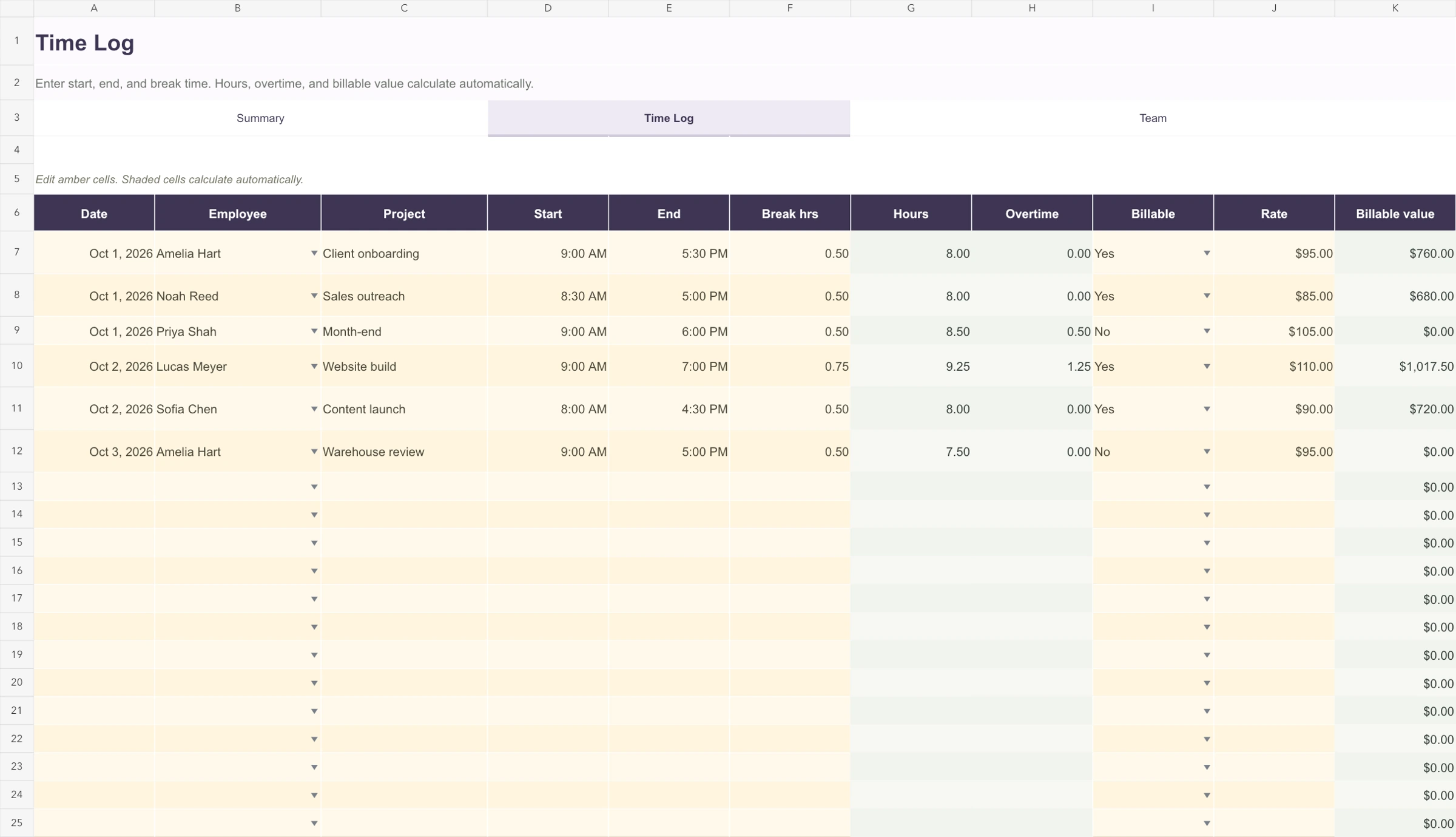 Open the worksheet preview
New to spreadsheets?
In Excel, use File > Save As and give your copy a name. Save again after making changes. Keep a fresh original for next time.
The names along the bottom are tabs. Click one to open it. A cell is one box: B7 means column B, row 7.
Click an amber cell, type, and press Enter. Press Tab to move right. Double-click a cell to edit part of its text.
Click a cell with a dropdown, then click its small arrow and choose a listed option. The field notes list the available choices.
Enter dates such as 11/06/2026 and amounts as numbers, such as 1250. Enter 50% for half. Keep the existing number formats.
Press Ctrl+Z on Windows or Command+Z on Mac immediately after a mistake. A formula starts with = in the formula bar; keep it in place.
Keep this beside your workbook
Review hours, overtime, billable time, and value by team member. Read the results here. Update the source tabs to change them.
Follow the steps above for this view. Use its amber settings where shown, and keep calculated totals and charts in place.
Enter start, end, and break time. Hours, overtime, and billable value calculate automatically. Editable cells begin at A7. Use the prepared amber rows for new records.
| Field and cells | What to do |
|---|---|
| Date A7:A46 | Enter a real date such as 11/06/2026. Use the same reporting period as the rest of the record. |
| Employee B7:B46 | Enter the name or label for this record. Use exactly the same spelling on other tabs that refer to it. Use the dropdown choices from Team!B7:B26. |
| Project C7:C46 | Enter the name or label for this record. Use exactly the same spelling on other tabs that refer to it. |
| Start D7:D46 | Enter the task start date. For a time-log row, enter a time such as 09:00. |
| End E7:E46 | Enter the end date for leave, or a time such as 17:30 in the time log. |
| Break hrs F7:F46 | Enter decimal hours: 0.5 means 30 minutes; 1 means one hour. |
| Billable I7:I46 | Replace the example with your own information for this record. Choose: Yes, No. |
| Rate J7:J46 | Enter a numeric value in the units shown by the heading. Use the example format and keep the period consistent. |
Maintain roles, rates, and weekly capacity for time entry. Editable cells begin at A7. Use the prepared amber rows for new records.
| Field and cells | What to do |
|---|---|
| Employee ID A7:A26 | Enter the name or label for this record. Use exactly the same spelling on other tabs that refer to it. |
| Employee B7:B26 | Enter the name or label for this record. Use exactly the same spelling on other tabs that refer to it. |
| Role C7:C26 | Enter the name or label for this record. Use exactly the same spelling on other tabs that refer to it. |
| Department D7:D26 | Replace the example with your own information for this record. |
| Hourly rate E7:E26 | Enter a numeric value in the units shown by the heading. Use the example format and keep the period consistent. |
| Weekly capacity F7:F26 | Enter a numeric value in the units shown by the heading. Use the example format and keep the period consistent. |
Make it part of your routine
The filled rows are examples. Replace or clear their amber input cells so sample records do not stay in your totals. Keep formulas and headings.
Enter 09:00 and 17:30 as times; a 30-minute break is 0.5 hours. Log rates are entered manually, so review them after changing Team.
Use the prepared amber area shown in the field notes. Before adding rows outside it, extend all formulas, dropdowns, charts, summaries, and any pivot source that uses that area.
Leave an unknown value blank. Enter 0 when you have confirmed there is none. If you see Complete inputs or Add dates, fill the missing source fields first.
Check for leftover example rows, missing dates or amounts, mismatched names, and text entered instead of numbers. If a formula was replaced, Undo or copy it from a fresh original.