Save your own copy
In Excel, use File > Save As and give your copy a name. Save again after making changes. Keep a fresh original for next time.
Your getting-started guide
Compare project contract value and budget with recorded costs.
Your first five minutes
Enter a project ID, project name, client, contract value, and cost budget.
See the fields in ProjectsRecord a dated cost and amount using the exact project name from Projects.
See the fields in Cost LogReview remaining budgets and gross profit. Check the Cost Log when a total looks unexpected.
See the fields in DashboardAmber: your entries. Type your information here.
Green: calculated results. Keep these formulas.
Status colors can change as you work. Use the field instructions below to confirm what you can edit.
Follow along in your copy
The workbook already contains illustrative records so you can see how it works. Find these cells, make a small change following the first steps, and review the result before entering your own information.
These are sample values. Replace or clear the amber example cells before relying on your totals.
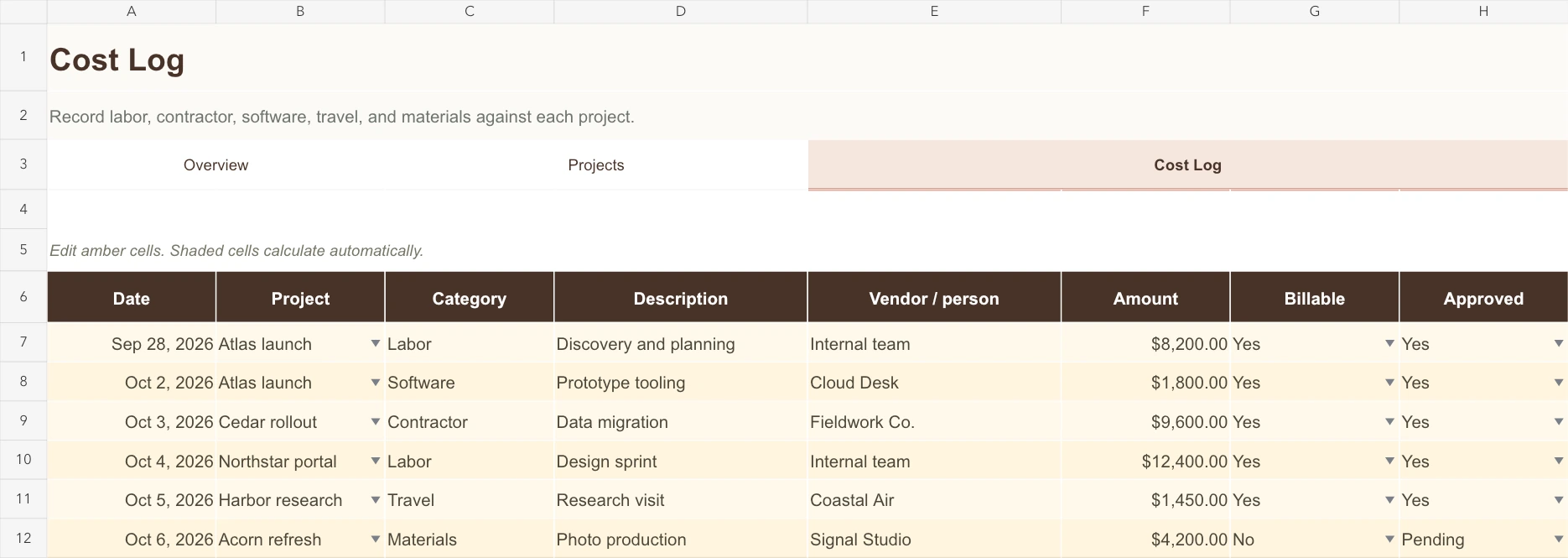 Open the worksheet preview
New to spreadsheets?
In Excel, use File > Save As and give your copy a name. Save again after making changes. Keep a fresh original for next time.
The names along the bottom are tabs. Click one to open it. A cell is one box: B7 means column B, row 7.
Click an amber cell, type, and press Enter. Press Tab to move right. Double-click a cell to edit part of its text.
Click a cell with a dropdown, then click its small arrow and choose a listed option. The field notes list the available choices.
Enter dates such as 11/06/2026 and amounts as numbers, such as 1250. Enter 50% for half. Keep the existing number formats.
Press Ctrl+Z on Windows or Command+Z on Mac immediately after a mistake. A formula starts with = in the formula bar; keep it in place.
Keep this beside your workbook
See project budgets, actual costs, remaining budget, and gross margin in one view. Read the results here. Update the source tabs to change them.
Follow the steps above for this view. Use its amber settings where shown, and keep calculated totals and charts in place.
Enter project terms. Cost, remaining budget, profit, margin, and status update from the cost log. Editable cells begin at A7. Use the prepared amber rows for new records.
| Field and cells | What to do |
|---|---|
| Project ID A7:A26 | Enter the name or label for this record. Use exactly the same spelling on other tabs that refer to it. |
| Project B7:B26 | Enter the name or label for this record. Use exactly the same spelling on other tabs that refer to it. |
| Client C7:C26 | Replace the example with your own information for this record. |
| Contract value D7:D26 | Replace the example with your own information for this record. |
| Cost budget E7:E26 | Enter a numeric value in the units shown by the heading. Use the example format and keep the period consistent. |
Record labor, contractor, software, travel, and materials against each project. Editable cells begin at A7. Use the prepared amber rows for new records.
| Field and cells | What to do |
|---|---|
| Date A7:A46 | Enter a real date such as 11/06/2026. Use the same reporting period as the rest of the record. |
| Project B7:B46 | Enter the name or label for this record. Use exactly the same spelling on other tabs that refer to it. Use the dropdown choices from Projects!B7:B26. |
| Category C7:C46 | Enter the name or label for this record. Use exactly the same spelling on other tabs that refer to it. |
| Description D7:D46 | Write a short, specific description that another person can act on or check. |
| Vendor / person E7:E46 | Enter the name or label for this record. Use exactly the same spelling on other tabs that refer to it. |
| Amount F7:F46 | Enter a numeric value in the units shown by the heading. Use the example format and keep the period consistent. |
| Billable G7:G46 | Replace the example with your own information for this record. Choose: Yes, No. |
| Approved H7:H46 | Replace the example with your own information for this record. Choose: Yes, Pending, No. |
Make it part of your routine
The filled rows are examples. Replace or clear their amber input cells so sample records do not stay in your totals. Keep formulas and headings.
A project cost is recorded once. Project names connect the two tabs, so update both if you rename a project.
Use the prepared amber area shown in the field notes. Before adding rows outside it, extend all formulas, dropdowns, charts, summaries, and any pivot source that uses that area.
Leave an unknown value blank. Enter 0 when you have confirmed there is none. If you see Complete inputs or Add dates, fill the missing source fields first.
Check for leftover example rows, missing dates or amounts, mismatched names, and text entered instead of numbers. If a formula was replaced, Undo or copy it from a fresh original.