A clearer way to work
Know the parts and cost of each build.
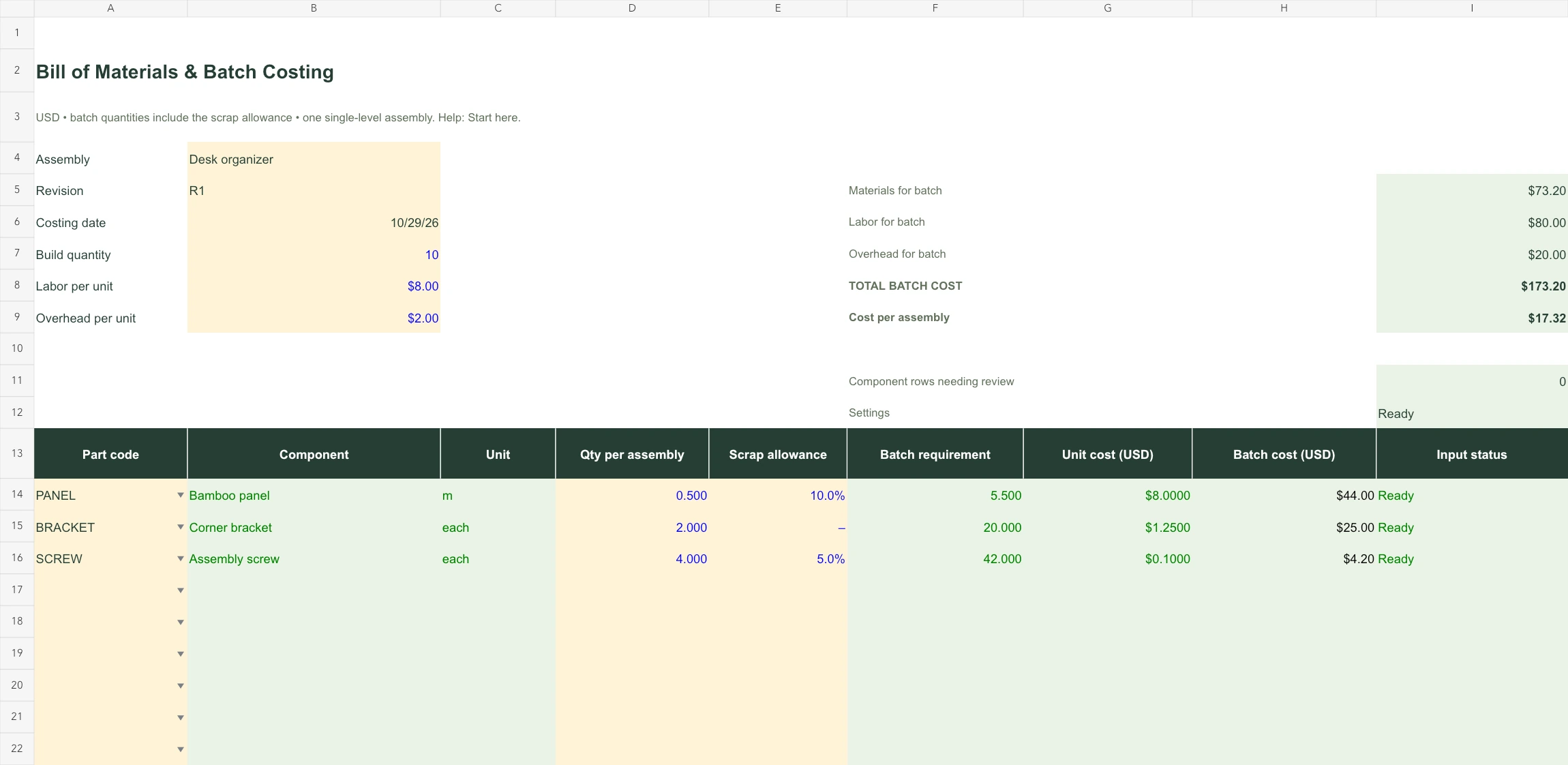
Build a single-level bill of materials from reusable part prices. Enter a batch quantity, include a scrap allowance, and compare material, labor, overhead, and total batch cost before starting production.
Small manufacturers, makers, and operations teams costing a repeatable assembly.
50 component lines and 100 reusable parts
Scrap allowances and whole-unit rounding
Material, labor, and overhead cost roll-up
20-entry manual revision history
One connected workbook
Take a look inside.
Start with the included guide, replace the example inputs, and review the calculated results.
Assembly
Set the product revision and batch size; enter component quantities and review batch cost.
Parts
Maintain 100 unique part codes, descriptions, units, prices, issue policies, and suppliers.
Revisions
Record 20 dated revisions manually; this is a history log, not an automatic snapshot archive.
 Explore the details
From download to your daily work
A useful start in three steps.
- 01
Parts: Replace examples in A8:F107. Each part needs a unique code, unit cost, and Whole or Fractional issue policy.
- 02
Assembly: Set the assembly and revision in B4:B5, costing date in B6, batch quantity in B7, and per-unit labor/overhead in B8:B9. Replace component inputs in rows 14–63.
- 03
Revisions: Save a dated workbook copy before changing prices or design. Record the revision and reason in the manual history, then review cost and input warnings.
The useful details
Before you make it yours.
How do scrap and whole-unit rounding affect the cost?
Required quantity is nominal quantity per assembly × (1 + scrap allowance) × batch size. Whole issue policy rounds that batch quantity upward; Fractional preserves decimals. Each batch line cost rounds to cents. Changing a reusable part price updates the current assembly; save a dated copy to preserve an earlier estimate.
What will I receive after purchase?
You receive the complete Bill of Materials & Batch Costing as an editable .xlsx file with 3 worksheets, sample data, and live formulas. Your paid order confirmation includes download links. Sign in to your GridMori account to keep purchased workbooks together in your library.
Do I need a subscription?
No. This workbook is a one-time $9 purchase. Choose any 3 different GridMori templates for $24 or any 5 for $32. Your bag applies $8-each pricing for 3–4 templates and $6.40-each pricing for 5 or more. Taxes are calculated at checkout.
Which spreadsheet app is it designed for?
Editable .xlsx for modern Microsoft Excel on Windows or Mac. No VBA macros. Other spreadsheet apps require import and review of formulas, charts, dropdowns, and layout.
Can I customize the workbook for my business?
Yes. Replace the example data, edit the input fields, and adapt the labels and appearance for your own work. Keep an original copy and check formulas and chart ranges when extending the prepared structure. A personal commercial-use license is included; it does not permit resale of the template.